| Xbox | |
|---|---|
| |
| |
| Basic Information | |
Type(s) |
Home Console |
Generation |
Sixth |
| Microsoft Corporation | |
Successor(s) |
Xbox 360 |
Competitor(s) |
PlayStation 2, GameCube, Dreamcast |
Unit(s) sold |
24,000,000+ (worldwide) |
| Halo 2 | |
| Technical Information | |
Networking |
Xbox Live (discontinued as of April 15, 2010) |
Storage |
8 or 10 GiB hard drive |
Supported Media |
DVD-ROM, DVD Video, Audio CD |
Save Capabilities |
Xbox Memory Card & Internal hard drive |
| Input(s) | |
| Xbox Controller,Xbox Controller S | |
 European Release European Release
| |
| March 14, 2002 | |
   North American Release North American Release
| |
| November 16, 2001 | |
 Japanese Release Japanese Release
| |
| February 22, 2002 | |
| Awards | Covers | Credits | Gallery | Help Patches | Reviews | Screenshots | Videos | |
The Xbox is the first home console from the Xbox series manufactured by Microsoft. It was released on November 15, 2001 in North America, followed by a release in Austraolia, Europe, and Japan in early 2002. It is part of the sixth generation of video game hardware, competing with Sony's PlayStation 2 and Nintendo's GameCube. It was the first major console produce by an American company since the release of the Atari Jaguar in 1993.
The console was announced in March 2000. With the release of the PlayStation 2, which featured the ability to playback CD-ROMs and DVDs in addition to playing games, Microsoft became concerned that game consoles would threaten the personal computer as an entertainment device for living rooms. Most game consoles up to that point were built from custom hardware components, but the Xbox was built around standard personal computer components using variations of Microsoft Windows and DirectX as its operating system to support games and media playback. The console also was built with direct support for broadband connectivity to the Internet via an integrated Ethernet port, and with the release of Xbox Live, a subscription-based online gaming service, a year after the console's launch, Microsoft gained an early foothold in online gaming and made the Xbox a strong competitor in the sixth generation of consoles.
The Xbox was a launch success in North America, selling 1.5 million units before the end of 2001, aided by the popularity of one of the system's launch titles, Halo: Combat Evolved, which sold a million units by April 2002. Despite its popularity, however, Microsoft lost over $4 billion druing its market life as they were unable to make a steady profit off the console due to its manufacturing price being far more expensive that its retail price. Furthermore, it underpeformend outside of Western markets, especially in Japan due to an overabundance of games marketed towards Americans and the console's large size. It was vastly outsold by the PlayStation 2, but outsold the GameCube and the Sega Dreamcast.
The system was discontinued on June 4, 2006 for Japan; March 11, 2007 for Europe; and March 2, 2009 for North America.
History
The Xbox was initially developed within Microsoft by a small crew, including Seamus Blackley, a game developer and high energy physicist.
While some critics were initially concerned that the Xbox would allow Microsoft to extend its dominance of the PC software market to consoles, as of 2005 estimates show that the Xbox's share of the worldwide console market is comparable to the GameCube, and far behind that of the PlayStation 2. The Xbox did not sell well in Japan, due to poor acceptance of non-Japanese consoles within that market. Couple with limited Japanese developer support, few game choices and the large size of the hardware itself, it made for a very poor offering for Japanese players. Microsoft predicted that it would not make a profit on the Xbox for at least three years and that turned out to be correct; the division had its first profitable quarter in 2005.[citation needed]
In November 2002, Microsoft released the Xbox Live online gaming service, allowing subscribers to play Xbox games online with (or against) other subscribers around the world, as well as offer a content downloaded service for games. This online service only worked with broadband. The milestone of 1 million subscribers was announced on July 8, 2004.
Several internal hardware revisions were made over the manufacturing life of the console to discourage modding, cut manufacturing costs, and to provide a more reliable DVD-ROM drive.
Discontinuation and successors
The successor to the Xbox, the Xbox 360, was officially announced on May 12, 2005 on MTV. It was released on November 22, 2005 in North America. Support for out-of-warranty Xbox consoles was discontinued on March 2, 2009. Support for Xbox Live on the console ended on April 15, 2010.
Hardware
Microsoft built the Xbox around industry-standard PC hardware, unlike the traditionally proprietary design of nearly all other gaming consoles.
The inclusion of the hard drive not only served as a disk cache for faster game loading times (compared to the Playstation 2) and repository for saved game information (eliminating the need for sold-separately memory cards), it also allowed users to download and save new content for their games from Xbox Live. Players were also able to copy music from standard Audio CDs, to partially or completely replace the soundtrack of Xbox games that supported custom soundtracks; these were all firsts in console history. Custom soundtracks were often supported in non-cinematic games (e.g. racing/driving games) where the music is inconsequential to what is happening in the game.
Although the Xbox is based on the x86 architecture and ran an operating system that is believed to have been inspired by the Windows NT architecture that powered Windows 2000, however, it is not a derivative of either. The Xbox also incorporated restrictions designed to prevent behaviour or functionality not approved by Microsoft.
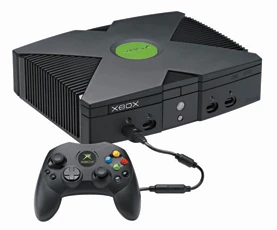
The Xbox is much larger and heavier than its contemporaries, and shipped with an unusually large controller. The size of the console is mainly due to the large, tray-loading DVD-ROM drive and the standard 3.5" hard drive. Despite managing to be smaller and lighter than similar commodity PCs, the Xbox has found itself a target of mild derision, as gamers poked fun at it for things like a warning in the Xbox manual that a falling Xbox "could cause serious injury" to a small child or pet. While some elements of the Xbox's design, like break-away cables for the controllers (to prevent the console from being yanked off the shelf) take the size of the console into account, it has undoubtedly hurt the system's sales to the space-conscious Japanese.
Another common complaint about the system was that the Duke controller was seen as too large for some people. For the Japanese Xbox launch, a new and smaller controller was introduced, a design which was subsequently released in other markets as the "Controller S", which eventually replaced the original design. Currently, all Xbox consoles come with a "Controller S", and the original version of the controller (also known as 'The Duke') is no longer sold.
Detailed specifications
- CPU: 733 MHz x86 Intel Pentium III CPU with a 133 MHz Front Side Bus
- Graphics Processor: 250 MHz custom chip named the NV2x, developed jointly by Microsoft and NVIDIA (comparable to a low-end NVIDIA GeForce 4 Ti graphics card)
- Total Memory: 64 MiB DDR SDRAM running at 200 MHz, supplied by Micron
- Memory Bandwidth: 6.4 GB/s
- Polygon Performance: 125 million flat-shaded polys/second
- (Microsoft figure. Some critics assert that the Xbox's polygon-per-second number is exaggerated by unrealistic testing conditions.)[citation needed]
- Sustained Polygon Performance: 100+ M/s (transformed and lit polygons per second)
- Micropolygons/particles per second: 125 M/s
- Particle Performance: 125 M/s
- Simultaneous Textures: 4
- Pixel Fill Rate - No Texture: 4 GB/s (anti-aliased)
- Pixel Fill Rate - 1 Texture: 4 GB/s anti-aliased
- Compressed Textures: Yes (6:1)
- Full Scene Anti-Aliasing: Yes
- Micro Polygon Support: Yes
- Storage Medium & I/O: 2-5x DVD-ROM drive, 8 GiB/10 GiB hard drive, optional 8 MiB Xbox Memory Card
- Audio Channels: 64 3D channels (up to 256 stereo voices)
- 3D Audio Support: Yes
- MIDI DLS2 Support: Yes
- AC3 (Dolby Digital) Encoded Game Audio: Yes (via TOSLINK)
- Broadband Enabled: Yes (10/100Mbps Ethernet)
- DVD Movie Playback: Yes (separate DVD Playback Kit required)
- Maximum Resolution (2x32bpp frame buffers +Z): 1920 × 1080
- Note: NTSC (Non-HD) TV's have less than 500 horizontal lines. PAL TV's have less than 600 horizontal lines.
- HDTV Support: Yes, 480p/720p/1080i
- Controller Ports: 4 proprietary-format USB ports
- Weight: 3.86kg
- Dimensions: 324mm × 265mm × 90mm (12.8" × 10.4" × 3.5")
Official Xbox accessories
Audio/video connectors
- Standard AV Cable: Provides composite video and monaural or stereo audio to TVs equipped with RCA inputs. Comes with the system. European systems come with an RCA-to-SCART converter block in addition to the cable.
- RF Adapter: Provides a combined audio and video signal on an RF connector.
- Advanced AV Pack: A breakout box that provides S-Video and TOSLINK audio in addition to the RCA composite video and stereo audio of the Standard AV Cable.
- High Definition AV Pack: A breakout box, intended for HDTVs, that provides a YPrPb component video signal over three RCA connectors. Also provides analog RCA and digital TOSLINK audio outputs.
- Advanced SCART Cable: The European equivalent to the Advanced AV Pack, providing a full RGB video SCART connection in place of S-Video, RCA composite and stereo audio connections (composite video and stereo are still provided by the cable, through the SCART connector, in addition to the RGB signal), while retaining the TOSLINK audio connector. As Europe had no HDTV standard at the time, no High Definition cable was provided in those markets.
Numerous unofficial third-party cables and breakout boxes were sold that provided combinations of outputs not found in these official video packages; however, with the exception of a few component-to-VGA transcoders and custom-built VGA boxes, the four official video packages represent all of the Xbox's possible outputs. This output selectivity is made possible by the Xbox's SCART-like AVIP port.
Networking
- Ethernet (Xbox Live) Cable: A Cat 5 cable for connecting the Xbox to a broadband modem or router (note that there is no "official" Xbox Live cable; any PC Ethernet cable can be used)
- Xbox Wireless Adapter: a wireless bridge which converts data running through an Ethernet cable to a wireless (802.11b or 802.11g) signal to connect to a wireless LAN. While the official Wireless Adapter guaranteed compatibility with the Xbox, almost any wireless bridge can be used.
- Xbox Live Starter Kit: A subscription and installation pack for the Xbox Live service, as well as a headset (with monaural earpiece and microphone) that connects to a control box that plugs into the top expansion slot of a controller. The headset can in fact be replaced with most standard earpiece-and-microphone headsets; headset specialist Plantronics produce various officially licensed headsets, including a special-edition headset for Halo 2.
- System Link Cable: A Cat 5 crossover cable for connecting two or four consoles together, for up to 16 total players. This functionality was similar to SEGA's DirectLink for the SEGA Saturn.
Multimedia
- Xbox Media Center Extender: A kit that allowed the Xbox to act as a Media Center Extender to stream content from a PC with Windows XP Media Center Edition installed. It could also be used for DVD playback.
- DVD Playback Kit: Required in order to play DVD movies, this kit included an infrared remote control and receiver. DVD playback was not included as a standard feature of the Xbox due to licensing issues with the DVD format that would have added extra cost to the console's base price. By selling a DVD remote separately, Microsoft was able to bundle the cost of the DVD licensing fee with it. Although there is nothing to prevent the Xbox from acting as a progressive-scan DVD player, Microsoft chose not to enable this feature in the Xbox DVD kit in order to avoid royalty payments to the patent-holder of progressive-scan DVD playback.
- Xbox Music Mixer: Utility software that came bundled with a microphone that connects to an adapter that plugs into the top expansion slot of a controller. This mixer provided a music player with 2D/3D visualizations as well as basic karaoke functionality. It also allowed users to upload pictures in JPEG format (to create slide shows) as well as audio in Windows Media Audio (WMA) and MP3 format (for karaoke or a game's custom soundtracks feature) from a Windows XP machine running the Xbox Music Mixer PC Tool.
Controllers and removable storage
- Standard Xbox Controller ("Controller O"): The normal Xbox controller for all territories except Japan, this wad replaced in Xbox packs by the "Controller S". The black and white buttons are located above the ABXY buttons, and the Back/Start buttons are located between and below the D-Pad and right thumbstick.
- "Controller S": A smaller, lighter Xbox controller. This was the standard Xbox controller in Japan, and it was released to other territories by popular demand, and eventually replaced the standard controller in the retail pack for the Xbox console. The white and black buttons are located below the ABXY buttons, and the Back/Select buttons are similarly placed below the left thumbstick.
- Memory Unit: An 8 MiB removable solid-state memory card onto which game saves can either be copied from the hard drive when in the Xbox Dashboard's memory manager, or saved during a game. Note that some games (e.g. Ninja Gaiden and Dead or Alive Xtreme Beach Volleyball) do not support this accessory, as a cheat prevention measure.
- Logitech 2.4 GHz wireless controller. Approved by Microsoft for wireless gameplay with the Xbox.
Xbox and DirectX
Microsoft's set of low-level APIs for game development and multimedia purposes, DirectX, was used as a basis for the Xbox's hardware programming (as well as its name, which implies "DirectX Box"). The API was developed jointly between Microsoft and NVIDIA, whose chips power the Xbox graphics. The Xbox API is similar to DirectX version 8.1, but is non-updateable just like other console technologies.
Modding the Xbox
The popularity of the Xbox inspired efforts to circumvent the built-in hardware and software security mechanisms (sometimes in order to use the Xbox as a low cost web server), as well as to add customized design touches to the console's case (similar to PC case modding). Hardware modding involved anything from simply replacing the console's green decorative "jewel" with a custom-designed one to opening up the case and installing a modchip.
Software modding is much less intrusive, and only involves running software exploits to trick the Xbox into running unsigned executable code. This allowed running an alternate dashboard such as Avalaunch, Evolution-X or UnleashX and in turn made playing original homebrew games through arcade and games console emulators possible. This was especially attractive as the Xbox is designed to output to TVs, and high-quality controllers and arcade sticks are available for use.
The original hard drive can also be replaced with a larger one. Then, Xbox games could be copied from the DVD to the hard drive, and then played directly from the hard drive. This required a modded Xbox using one of the alternative dashboards, and is used by scrupulous users to eliminate load times or leave their games in storage, and by unscrupulous users to play illegally copied games.
Beyond gaming, a modded Xbox can be used as a media center with the Xbox Media Center software (XBMC), which allowed the playing of DVDs without the $30 DVD kit, and also allowed the user to play music and video files from the Xbox hard drive, or stream it from another computer over a network. A modded Xbox can even be configured to run Linux or a Microsoft Windows as its operating system. ReactOS also had a version capable of loading on the Xbox, but development of this was discontinued.
Modding an Xbox may require opening the Xbox case, and most internal hardware modifications will render an Xbox unable to participate in Xbox Live, which is why many modders used a switch to enable them to enable or disable the modifications to the Xbox at will. As of November 2004, Microsoft took new action, and banned Xboxes with hard drive modifications from the Xbox Live service.
See also
References