This is an outdated page that references or contains outdated information. This page should be edited to include more recent information.
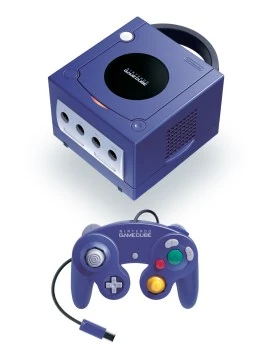
A Nintendo GameCube
Console is a term used to describe a home video game playing device. What separates a console from an arcade machine is that a console has interchangeable games (usually stored on a type of cartridge or optical disc) and a much smaller size. They can also be handheld consoles, like the Game Boy Advance and Nintendo DS.
Often the output device is a separate television or a computer monitor. Once, video game consoles were easily distinguishable from personal computers: consoles used a standard television for display, and did not support standard PC accessories such as keyboards or modems. However, as consoles have become more enhanced, the distinction has blurred: some consoles can have full Linux operating systems running with hard drives and keyboards (like the Sega Dreamcast) (one university has even created a Beowulf cluster of PlayStation 2 consoles), and Microsoft's Xbox is basically a stripped down PC running a version of Microsoft Windows.
Many older video game consoles live on in the form of emulators, since the original hardware is no longer produced and can be very hard to find.
Although the first computer games appeared in the 1950s, they were based around vector displays, not analog videos. It was not until 1972 that Magnavox released the first home video game console which could be connected to a TV set—the Magnavox Odyssey, invented by Ralph H.Baer. The Odyssey was initially only moderately successful, and it was not until Atari's arcade game Pong popularized video games, that the public began to take more notice of the emerging industry. By the autumn of 1975 Magnavox, bowing to the popularity of Pong, cancelled the Odyssey and released a scaled down console that only played Pong and hockey, the Odyssey 100. A second "higher end" console, the Odyssey 200, was released with the 100 and added onscreen scoring, up to four players, and a third game—Smash. Almost simultaneously released with Atari's own home Pong console through Sears, these consoles jump-started the consumer market. As with the arcade market, the home market was soon flooded by dedicated consoles that played simple Pong and Pong-derived games. The best-selling first-generation console was the Nintendo Color TV Game, which was released in 1977 and had hardware updates up until 1980.
Second generation: Early 8-bit consoles (1976-1983)
Fairchild released the Fairchild Video Entertainment System (VES) in 1976. While there had been previous game consoles that used cartridges, either the cartridges had no information and served the same function as flipping switches (the Odyssey) or the console itself was empty and the cartridge contained all of the game components. The VES, however, contained a programmable microprocessor so its cartridges only needed a single ROM chip to store microprocessor instructions.
RCA and Atari soon released their own cartridge-based consoles. The Atari VCS, later renamed the Atari 2600, became the best-selling console of this generation. However, the second generation came to an abrupt end with the video game industry crash of 1983 (see Video Game Crash of 1983).
In 1983, Nintendo released the Family Computer (or Famicom) in Japan. The Famicom supported high-resolution sprites, scrolling tiled backgrounds, and more colors. This allowed Famicom games to be longer and have more detailed graphics. Nintendo brought their Famicom over to the US in the form of the Nintendo Entertainment System (NES) in 1985. In the US, video games were seen as a fad that had already passed. To distinguish its product from older video game consoles, Nintendo used a front-loading cartridge port similar to a VCR on the NES, packaged the NES with a Super Mario Brothers game and a light gun (the Zapper), and originally advertised it as a toy. The plastic "robot" (R.O.B.) was also sold as an individual purchase item and in some cases packaged with the NES system.
Like Space Invaders for the 2600, Nintendo found its breakout hit game in Super Mario Bros. Nintendo's success revived the video game industry and new consoles were soon introduced in the following years to compete with the NES.
Sega's Master System released in 1983 and was intended to compete with the NES, but never gained any significant market share in the US and was barely profitable. It fared notably better in PAL territories, especially Europe and Brazil, regions where it sold significantly better than the NES. While the NES sold more units worldwide, despite the Master System's lead in PAL regions, the Master System out-lasted the NES; the Master System still had games released in PAL regions up until 1998, thirteen years after it released and fifteen years after the third generation began.
The fourth generation began with the release of NEC's PC Engine/TurboGrafx-16 in 1987. Sega gained significant market share in North America by releasing its next-generation console, the Mega Drive/Genesis, which was released in Japan on October 29, 1988, in the U.S. in August 1989 (renamed as the Sega Genesis) and in Europe in 1990, two years before Nintendo could release the Super Nintendo Entertainment System (SNES).
Sega extended the Mega Drive with the Mega CD/Sega CD, to provide increased storage space for multimedia-based games that were then in vogue among the development community. Later, Sega released the 32X, which added some of the polygon-processing functionality common in fifth-generation machines. However, the peripheral was a commercial failure due to lack of software support, with developers more keen to concentrate on more powerful machines, with a wider user base, such as the Saturn that followed shortly after.
The other major console was SNK's Neo Geo, the most powerful console of this generation. Despite selling less units than the SNES, Mega Drive, and PC Engine, the Neo Geo out-lasted them all, still having games released up until 2004, fourteen years after it began and seventeen years after the generation began. This makes the Neo Geo the longest-lasting console of all time and the fourth generation the longest-lasting console generation.
The first fifth generation consoles were the FM Towns Marty, 3DO and Atari Jaguar. These systems were much more powerful than the Super Nintendo Entertainment System (SNES) or Mega Drive (known as Genesis in North America); they were better at rendering polygons, could display more onscreen colors, and the 3DO used discs that contained far more information than cartridges and were cheaper to produce. Neither of these consoles were serious threats to Sega or Nintendo, though. The 3DO cost more than the SNES and Genesis combined, and the Jaguar was extremely difficult to program for, leading to a lack of games that used its extra power. Both consoles would be discontinued in 1996. Bandai introduced an Apple Macintosh based console called the Pippin that was more like a low cost computer than a high end console, but did poorly in the market.
Nintendo released games like Donkey Kong Country that could display a wide range of tones (something common in fifth generation games) by limiting the number of hues onscreen, and games like Star Fox that used an extra chip inside of the cartridge to display polygon graphics. Sega followed suit, releasing Vectorman and Virtua Racing (the latter of which used the Sega Virtua Processor).
It was not until Sega's Saturn, Sony's PlayStation, and the Nintendo 64 were released that fifth generation consoles started to become popular. The Saturn and PlayStation used CDs to store games, while the N64 used cartridges. All three cost far less than the 3DO, and were easier to program than the Jaguar. The Saturn also had 2D sprite handling power on par with the Neo-Geo.
Atari's Jaguar was released to combat the dominance that Nintendo and Sega were fighting for. Atari's hope was that by designing a more powerful console, it would be able to leapfrog all of the released systems of the day and give gamers a technologically superior system. The Jaguar eventually faded away due to a number of reasons. For example, it was difficult to program, thus making it too problematic to have good third-party support. Another of the Jaguar's pitfalls was the dominance of the previously popular systems. In 1995, the releases of the Sega Saturn and the PlayStation brought the end for the Jaguar. The failure of the Jaguar put Atari into a poor financial situation and forced it to reverse merge with JTS Inc., a short-lived maker of hard disk drives, to form JTS Corporation. The merger effectively ended the company, which existed as a small department for minor support of the Jaguar and the selling off of Atari's intellectual properties.
The 3DO was released in North America in October 1993. Although released to much fanfare, like the Jaguar, it faded out of the market with little popularity. The system was technically superior to all the consoles released at the time, but due to the oversaturated market and the hefty US$699.95 price tag, the system did not adopt well into the market. One unique aspect of the 3DO is that the rights to manufacturing the console itself were licensed to different manufacturers by the 3DO company, which only produced the specifications. These companies, in turn, released their own different styles of the same console.
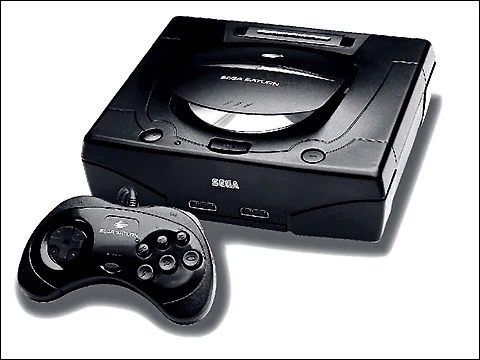
The Sega Saturn was released in North America on May 11, 1995 as the first independent Sega system
The Sega Saturn.
to use a CD-ROM based media standard, besides the Sega CD add-on for Sega Genesis, and used a special dual chip processor. The difficulty to program for the two chips in parallel was a factor in the console's demise. The Saturn was a mild success, but was overshadowed by Sony and Nintendo's dominance of the market. The Saturn was discontinued in 1998 with the release of Sega's last console, the Dreamcast.
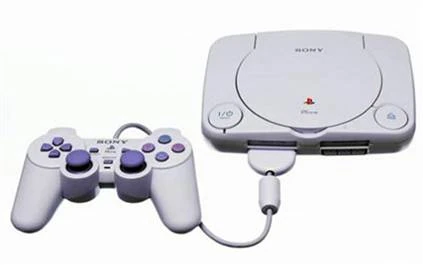
Sony's PlayStation was released in Japan on December 3, 1994 and in North America on September 9, 1995. The PlayStation was the eventual result of a breakdown of a business partnership plan between Sony and Nintendo to create a CD add-on for the SNES. Nintendo changed the deal and went to Philips; however, with the project nearing completion, Sony took what it had and marketed it off as a Sony-branded console. The PlayStation spawned a whole lineup of consoles from generation to generation and has earned Sony great respect as a video game company, becoming the first video game system to sell over 100 million consoles. Sony released a redesigned, smaller version of the PlayStation entitled the 'PSone' on July 7, 2000.
The Original PlayStation.
The Nintendo 64 was released in North America on September 29, 1996 as Nintendo's answer to the growing dominance of the PlayStation. It was a 64-bit console, the only one generally recognized in that class despite the 64-bit Atari Jaguar, which had actually been released earlier. Unlike the other companies' consoles of the generation, the N64 had continued to use ROM cartridges, which many saw as a hindrance to gameplay, as cartridges have much less memory space and are also more expensive than optical media; however, Nintendo's answer to this was that unlike CDs, cartridges cannot be damaged by a simple scratch to the surface, load times are not much of an issue, and save data can be stored on the cartridge rather than on a memory card. Nevertheless, some believe that Nintendo did this for fear of then growing software piracy issues facing other consoles, such as the PlayStation. Sony would dominate most of the software market using CD instead of cartridges.
This generation saw a move towards arcade and PC like architectures in gaming consoles, as well as a shift towards using DVDs for game media. This brought games that were both longer and more visually appealing. Furthermore, this generation also saw experimentation with online console gaming and implementing both flash and hard drive storage for game data.
Sega's Dreamcast released in North America on September 9, 1999 was the company's last video game console, and was the first of the generation's consoles to be discontinued. Sega implemented a special type of optical media called the GD-ROM. These discs were created in order to prevent software piracy, which had been more easily done with consoles of the previous generation; however, this format was soon cracked as well. It was discontinued in 2002, and Sega transitioned to software developing/publishing only. It also sported a 33.6Kb or 56k modem which could be used to access the internet or play some of the games, like Phantasy Star Online, online.
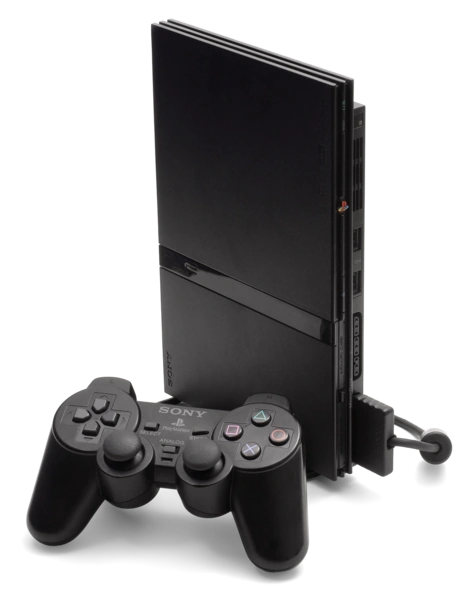
Sony's PlayStation 2 was released in North America on October 26, 2000 as the follow-up to its highly successful PlayStation, and was also the first home game console to be able to play DVDs. As was done with the original PlayStation in 2000, Sony redesigned the console in 2004 into a smaller version. As of July 2008, 140 million PlayStation 2 units have been sold. This makes it the best selling console of all time to date.
The PS2 Slim line.
The Nintendo GameCube, released November 18, 2001 in North America, was Nintendo's fourth home video game console and the first console by the company to use optical media instead of cartridges. The Nintendo GameCube did not play standard 12 cm DVDs, instead employing smaller 8 cm optical discs.
Microsoft's Xbox, released on November 15, 2001 in North America, was the company's first video game console. The first console to employ a hard drive right out of the box to save games, and had similar hardware specifications to a low-end desktop computer at the time of its release. Though criticized for its bulky size, which was easily twice that of the competition, as well as for the awkwardness of the original controller that shipped with it, it eventually gained popularity due in part to the success of the Halo franchise. The Xbox was the first console to include an Ethernet port and offered high speed online gaming through the Xbox LIVE service.
The features introduced in this generation include the support of new disc formats: Blu-ray Disc, utilized by the PlayStation 3, and HD DVD supported by the Xbox 360 via an optional $200 internal accessory addition, that was later discontinued as the format war closed. Another new technology is the use of motion as input, and IR tracking (as implemented on the Wii). Also, all seventh generation consoles support wireless controllers.
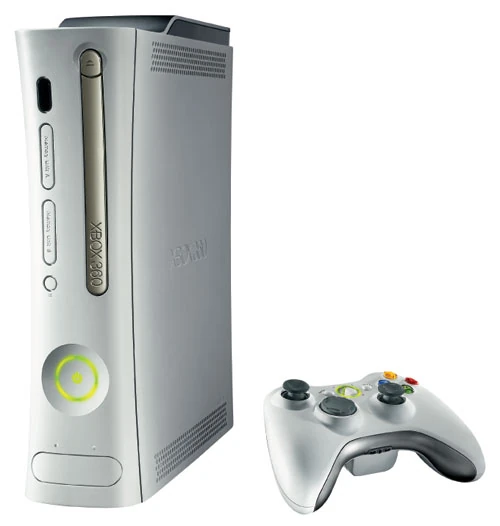
Microsoft kicked off the seventh generation with the release of the Xbox 360 released on November 22, 2005 in the US. It featured processing power never before seen until Sony rivaled back with its PlayStation 3 one year later. All Xbox 360s come with a hard drive (except for the 4GB SSD version) and additionally
The Xbox 360.
play DVD games as well as DVD movies out of the box. The Xbox 360 has HDMI output, but can only natively display 720p, which is HD, unlike the PlayStation 3, which can natively display 1080p, Full HD. The 720p on the Xbox 360 can be upscaled to 1080p Full HD, which would render the same quality effects as the PlayStation 3, but this would be done by the TV that you have the Xbox 360 connected to (if TV is capable). You can have up to four controllers connected to the console wirelessly on the standard 2.4 GHz spectrum. There are 3 discontinued versions of the Xbox 360: the "Arcade," the "Arcade Pro," and the "Elite." The two current shipping versions of the Xbox 360 are: a "slim" 4GB SSD version and a "slim" 250 GB HDD version. The motion gaming capabilities of this console is named the "Kinect."
Sony PlayStation 3 was released in Japan on November 11, 2006, in North America on November 17, 2006 and in Europe on March 23, 2007. All PlayStation 3s come with a hard drive and are able to play Blu-ray Disc games and Blu-ray Disc movies out of the box. The PlayStation 3 was the first video game console to support HDMI output out of the box, utilizing full 1080p resolution. Up to seven controllers can connect to the console using Bluetooth. There are 6 discontinued versions of the PS3: a 20 GB HDD version (discontinued in North America and Japan, and was never released in PAL territories), a 40 GB HDD version (discontinued), a 60 GB HDD version (discontinued in North America, Japan and PAL territories), 80 GB HDD version (only in some NTSC territories and PAL territories), a "slim" 120GB HDD version (discontinued), and a "slim" 250 GB version (discontinued). The two current shipping versions of the PlayStation 3 are: a "slim" 160 GB HDD version and a "slim" 320 GB HDD version. The hard drive can be replaced with any standard 2.5" Serial ATAdrive and the system has support for removable media storage, such as Memory Stick, Memory Stick Pro, Memory Stick Duo, Memory Stick PRO Duo, USB, SD, MiniSD, and CompactFlash (CF) digital media, but only the PlayStation versions up to 80 GB support this. The slim PlayStation 3 consoles (120 GB and up) had removable storage discontinued. The motion capabilities of this console is named the "PlayStation Move." You hold one main controller in your dominant hand (usually the right) and an optional second controller in your recessive hand (usually the left). The "PlayStation Move's" controllers are always accurately being tracked by a camera.
Nintendo Wii was released in North America on November 19, 2006, in Japan on December 2, 2006, in Australia on December 7, 2006, and in Europe on December 8, 2006. It is bundled with Wii Sports and Wii Sports Resort in all regions except for Japan. Unlike the other systems of the seventh generation, the Wii does not support an internal hard drive, but instead uses 512 MB of internal Flash memory and includes support for removable SD card storage. It also has a maximum resolution output of 480p, making it the only seventh generation console not able to output high-definition graphics. Along with its lower price, the Wii is notable for its unique controller, the Wii Remote, which resembles a TV remote. The system utilizes a "sensor bar" that emits infrared light that is detected by an infrared camera in the Wii Remote to determine orientation relative to the source of the light. Like Nintendo's hand-held systems, it is also backwards compatible with previous Nintendo consoles, as it is capable of playing Nintendo GameCube games and supports up to four Nintendo GameCube controllers and two memory cards. It also includes Virtual Console, which allows the purchase and downloading of games from older systems, including those of former competitors. The latest addition to the Wii is the 'Wii Motion Plus', which uses the same technology as the console previously used, but with enhanced motion tracking and sensing to improve gameplay quality. The Wii has three colors: a white one, a black one, and a red one. They both come with Wii Sports, Wii Sports Resort, and Wii Motion Plus, a controller add-on to make it more accurate.
On November 18, 2012, Nintendo released the Wii U, the first home console of the 8th generation. Sony and Microsoft later released their console successors in 2013, the PS4 and Xbox One, respectively.